
(This piece was updated on March 29, 2026 with added context, cast information, and minor revisions). There are two types of people who dive (whether voluntarily or not) into a Quentin Tarantino movie. The first are those who brace themselves for the blood and gore about to follow, half-gritting their teeth. The other are those who look forward to it, recognizing that these very signature elements, dismissed by some as hyperbolic, are what make his films so quintessentially real, so very rooted and earthy.
Tarantino’s films drag you down to their level and make you confront them head on—which is not to say that they are ‘fallen’ but simply to suggest that they like to wrestle with darkness, revel in it, and expose it for what it really is.
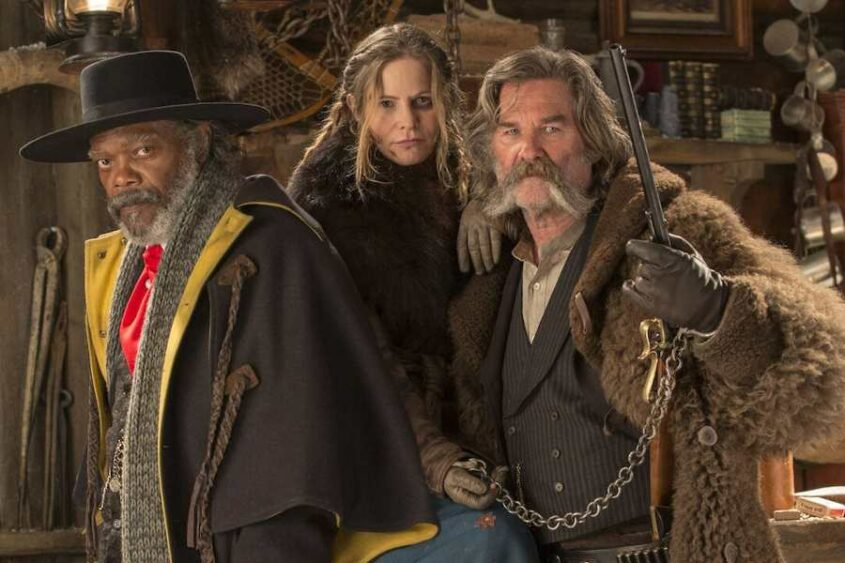
Tarantino’s Great Western sprawling magnum opus The Hateful Eight (2015) stars Samuel L. Jackson, Kurt Russell, Jennifer Jason Leigh, Walton Goggins, and Demián Bichir. It really begins to unfold in a haberdashery, where eight people are ostensibly thrown together by coincidence and forced to stay together as a blizzard rages outside.
The thrust of the story begins on a slightly languorous, mellow note punctured with bursts of violence and blood, which are, of course, intrinsic to the Tarantino universe.
By the end of the first 60 minutes, the pace of the film has accelerated rapidly. After that, it just flows, even cascades on its own, tumbling about but heading determinedly towards its end with thirsty passion.
The Hateful Eight demonstrates, with cinematic flourish, the logic of brutality stitched in its every cell. Tarantino confronts all the ugly things of life we like to hide behind a veneer of politeness and splashes it on the screen in his nihilistic, macabre fashion.
The relationship he strives to make with viewers is strikingly unequal; he taunts us, enjoying our mutual repugnance and perverse fascination towards these ugly things; he uses his movie as bait to document our betrayal towards our civilised selves.
In fact, Tarantino’s greatest success may be that he succeeds in inscribing his own vision of the film and transferring it onto the reader’s mindscape.
The final impact of the movie stays with the viewer, who in this unlikely intimacy, is seduced and trapped, implicated and maybe even framed by Tarantino’s heady skill.
As an auteur, the director makes sure to let it be known to the viewer that s/he is powerless to restore or maintain any sort of resolution.
Significantly, Tarantino divides his films into ‘chapters’ (not ‘parts’) that highlight his auteurial stamp on his filmic universe.
Using plot devices like Abraham Lincoln’s letter (a quintessential Hitchcockian MacGuffin) or casually inserting an unnamed narrator in the second half of the film to explain the events taking place, he emphasises the tone of his movie through Ennio Morricone’s brilliant score which is devastatingly in conjunction with the storyline.
Acting as the hangman of the movie, he illustrates their bloody end and makes sure each character has what is coming to them.
There may be complaints that racial slurs are hurled excessively, or that Leigh’s character is beaten about a little too much. The logic of the film makes its amply clear that it will not shy away from displaying anything that may be true.
Apparently setting the film in the latter half of the nineteenth century, Tarantino tells the context like it was and demands it from us that we stomach it, that we not deny the historically charged resonances their due.
In this Manichean world of black and white, the director shows us the rise of the underdog and highlights the black man’s revenge depicted as a long soliloquy, where he tells of racial and sexual domination and attempts to reclaim and rewrite history.
The resultant effect, then, is somewhat of an explosion. The film explodes like an orga** on the screen— uncontrollable, undeniable, and writhing in the pleasure of its own stimulation.
And maybe this is what makes The Hateful Eight finally so irresistible. It laughs in the face of its own vulgarity, makes a poem out of it, embellishes it as lyrical prose, and transforms it into pure cinema.
Rating: 4/5
Recommended Reads
All 10 Quentin Tarantino Movies, Ranked
15 Best Western Movies Of All Time
Pulp Fiction (1994) Screenplay Analysis
Inglourious Basterds (2009) Screenplay Analysis
100 Best Gangster Movies Of All Time
Django (1966) Review: Bleak, Bold And Unforgiving
How To Write Great Dialogue
